Five Strategies for Winning Your Golf One And Done Pool
Want to win your PGA golf One And Done pool? Make smarter picks by incorporating these strategy tips and data-driven advice.
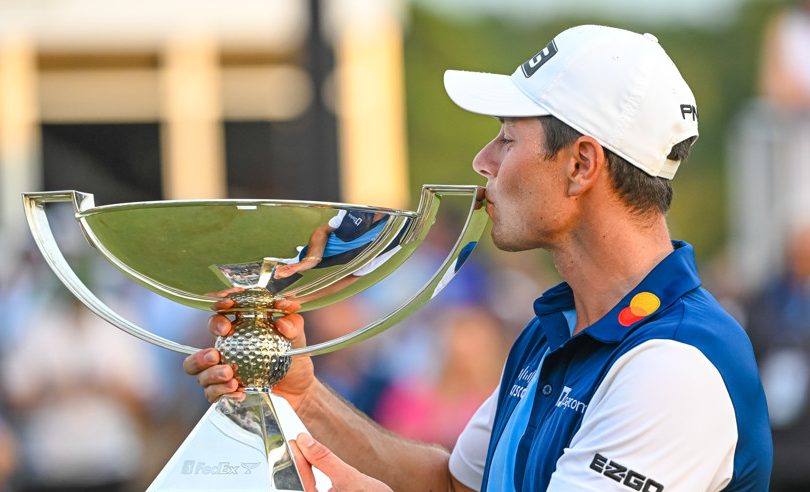
Viktor Hovland won some One And Dones with his victory at the BMW Championship in 2023 (John Adams/Icon Sportswire)
In Golf One and Done pools, strategic foresight meets the unpredictable nature of the golf course.
The stakes are high as pool contestants navigate the ever-changing landscape of the PGA Tour, aiming to maximize their winnings while carefully managing player selections. Whether you’re a seasoned golf enthusiast or a more casual fan who just likes to play in sports contests for the action, Golf One and Done pools promise an engaging journey through the highs and lows of golf.
Golf Pool Picks
Get an edge in your One And Done and Majors pools
Golf One and Done Pool Basics
A “One And Done” Pool is so named because in this unique competition, participants typically pick one PGA golfer for each tournament of the season, with the caveat that once a golfer is picked, they cannot be used as pick again for the rest of the season.
In that way, a One and Done pool is a lot like an NFL survivor pool, where you have to think strategically about when you want to “burn” a particular golfer.
In survivor pools, a single poor result can lead to elimination, but the Golf One and Done format is much more forgiving of bad outcomes. Instead, a few great results can make up for weeks of frustration.
The format challenges participants to navigate the inherent difficulty of picking golf tournament winners (even among the favorites). In golf, the unpredictability factor is high, with even the very top players usually having relatively modest odds of only around 10% to win a given tournament.
With enough opportunities, though, your hope is to hit the big winners in a handful of tournaments, so you can come out on top of your One And Done pool at the end of a long PGA season.
Just like every other sports pool, to give yourself the best chance to win a One And Done, you need to have the best strategy. Yes, it still takes luck to win. But as we like to say, the better your strategy, the less luck you need.
Here are five tips to increase your chance to win a Golf One And Done pool:
- Know Your Specific One And Done Rules
- Understand What Wins Golf One And Dones
- Use the Best Golfers in the Biggest Purse Events
- Adjust Your Strategy Based on the Standings
- Don’t Give Up
1) Know Your Specific One And Done Pool Rules
The standard “One And Done” Pool requires players to pick one golfer each tournament, and limits you to picking each golfer once per season. But there are a lot of variations, and all of them can impact your strategy. Some potential variations include:
- The specific tournaments included
- The scoring format used
- Whether some tournaments require more than one pick
- Whether some golfers can be re-used
- The number of prize payout spots or percentage of pool that gets paid out
- Rules on substituting or replacing golfers that withdraw
- Whether there are season segments that have their own prize structure
Based on our research, lots of One And Done pools start in January and early February, and most of them extend through the FedEx Cup Playoffs. But there is plenty of variability regarding which specific tournament they start with, and also on whether or not they include the final TOUR Championship event (since it has a unique prize structure).
The exact number of tournaments included in your pool, and how many players you have to pick in total over the length of the contest, can significantly impact your ideal pick strategy.
The most common scoring format is to use the prize purse money won by the golfer in that event for the score, but there are also variations on that theme which might cause you to approach your pick making at least somewhat differently.
2) Understand What Wins One And Done Pools
In the typical Golf One And Done Pool that uses prize money won as the scoring metric, picking golfers that win tournaments is the key. Let’s take a look at the prize purse payouts for The Masters in 2023 as an example:
- John Rahm, 1st place: $3,240,000
- Phil Mickelson and Brooks Koepka, tied for 2nd place: $1,584,000 each
- Jordan Spieth, Patrick Reed, and Russell Henley, tied for 4th place: $744,000 each
The difference between finishing 1st place and tied for 2nd place, in terms of prize money, was greater than the difference between 2nd place and someone who missed the cut.
Analyzing Top-Performing vs. Average Entries
We scrutinized both the top-performing entries and entries with average scores in a prominent national One And Done Contest from 2023. If you looked at a typical week, you might not be able to tell them apart, and you certainly could not do so by their worst weeks.
On average, the top entries missed the cut in 5.0 tournaments, while the average-finishing entries missed the cut in 5.4 tournaments.
The difference was at the top, in a handful of tournaments. The top entries had a week where they earned more than $2 million in prize money 4.2 times (basically, a 1st or 2nd place in the biggest money events), compared to 0.6 times for the average entries.
About 65% of the points for a top-finishing entry came from their best five events for the season, and 96% of the points came from the upper half of outcomes.
The top entries averaged a stretch of at least 4+ tournaments consecutively where they never earned more than $200,000 with a golfer. The difference was in the handful of events they did hit big.
In short, hitting tournament winners is what wins One And Done pools—it’s a home run game. Avoiding players who miss cuts? Not so much. That happens to winners and losers alike.
3) Use the Best Golfers in the Biggest Purse Events
So how do you give yourself the best chance to win big purses? For starters, use the best golfers in events where they have the potential to win the most money when they succeed.
Although One And Done pools typically necessitate making picks across 30 or more tournaments, it’s essential to recognize that not all tournaments are equal in terms of prestige and prize purses.
About half (or more) of tournaments in a typical One And Done will have significantly lower prize purses. The biggest purse events (e.g. the Majors, The Players Championship, what the PGA Tour calls “Signature Events,” and the FedEx Playoff Tournaments) have much larger prizes for first place than other tournaments.
Picking a golfer that wins one of those higher-value events can be worth more than double the value of picking the winner in another event. Getting a 2nd or 3rd place finisher can also be worth more than picking a tournament winner in a lower-value tournament.
Why Matching Golfer Quality Matters
Think of competing in a One And Done Pool as trying to do well on two different dimensions. First, you want to get more points than your opponents in that particular tournament. Second, and especially for the top golfers, you want to get more points when you use that specific golfer, than your opponents do when they use the same golfer in a different tournament.
Those goals can sometimes conflict, and you are forced to prioritize one. With 30+ golfers to pick, you cannot take the best option each week.
In plenty of weeks, you have to pick a golfer who is not the favorite, hoping for an outlier result. To minimize the downside, you also want to concentrate those picks on the events where the downside is lowest: the lower-money events, where the difference between finishing well and poorly is reduced.
Conversely, choosing a top-performing golfer in an event with a capped maximum earning, such as $1.4 million, often results in automatic disadvantage. In this scenario, you are inherently conceding points to a segment of the pool that selects the same golfer in a different, potentially more lucrative, tournament.
The Jon Rahm Example
Let’s use the example of picks on Jon Rahm in the 2023 PGA season.
Rahm won four tournament events, finished as a runner-up in two others, plus had a third place finish. So there were multiple tournaments where he finished highly. Not all of those finishes were equally beneficial to One And Done players, though.
Here was the prize money he won in all top three finishes:
| Event | Finish | Prize Money |
|---|---|---|
| Genesis Invitational | 1st | $3,600,000 |
| The Masters | 1st | $3,240,000 |
| Sentry Tournament of Champions | 1st | $2,700,000 |
| The American Express | 1st | $1,440,000 |
| WM Phoenix Open | 3rd | $1,380,000 |
| The Open | tied 2nd | $1,084,625 |
| Mexico Open | 2nd | $839,300 |
If you used Rahm at the American Express or Mexico Open, you ended up with a really good result, but it probably cost you in terms of your overall odds to win your One And Done. Rahm won significantly more money at three other events, and top golfers like Rahm will be used across all the big events they play. So at least some of your pool competitors most likely got significantly more points when they chose to pick Rahm.
You don’t want to limit your upside with the best golfers by using them in events where their winnings are capped at lower amounts, even if it’s tempting to do so when they are heavier favorites against weaker fields.
4) Adjust Your Strategy to the Standings As The End Game Nears
Because One And Done pools are heavily influenced by hitting tournament winners, and because you are competing in a pool against others, you always need to think about how your opponents are likely to behave.
Early on in the pool, you shouldn’t obsess about this as much, though. The top golfers in a given week are likely to have higher popularity, but it’s all relative. There are more options to pick from in a Golf One And Done pool than in an NFL survivor pool, for instance, so you are less likely to see something like 40% of your pool’s picks concentrated on one specific choice (which does happen in NFL survivor pools).
With so many tournaments and so many players to consider, the odds of your picks exactly duplicating an opponent’s entry over most of the season is slim. Entries will have natural variation, even if taking semi-popular options regularly.
As you get deeper into the PGA season, though, you need to think about how overall pick popularity in your pool will go. If you are in a leading position, going with a more popular pick can keep you in front of a larger segment of the pool.
If you find yourself trailing in your pool’s leaderboard, on the other hand, you may need to pick a winner that few others will pick, giving yourself the chance to make a last-minute leap in the pool standings.
The LIV Player Example
As an example, consider how to handle the players on the LIV Tour. Masters Champion Jon Rahm and PGA Champ Brooks Koepka are both now playing on the LIV Tour. They are barred from playing in PGA events, but will play in the Majors. Because they aren’t playing in those other events, they will be more available as One And Done picks and should be among the more popular picks for the Majors.
Whether you should consider them as your picks may depend on your place in the pool standings. If you are trailing your pool’s leaders by a large margin, it may make more sense to fade the popular option and hope they do not win the event.
Last year’s US Open featured Koepka as a popular pick, coming off his PGA Championship win a month earlier. But it was a seldom-picked Wyndham Clark who won.
It’s likely no strategic accident that one of the entries to come from far behind to finish near the top of a large pool we reviewed picked Clark for the US Open, while numerous entries that stayed behind the leaders took Koepka.
When To Think About Strategy Adjustments
The optimal time to think about adjusting your strategy to avoid or pick popular options when available is entry-dependent. Things like the distance behind a prize position, number of big events left, and how many others in your pool still have a certain golfer to pick all play a role.
That said, Memorial Day is probably a pretty good time to assess where you stand and think about any strategy shifts. The three-tournament stretch in June of The Memorial, U.S. Open, and Travelers Championship represent three of the bigger money events.
Once those tourneys have passed, most One And Done Pools will be down to The Open and the two FedEx Playoff events as the only remaining big money events, and 80% of the big purse events will be completed.
5) Don’t Give Up
Finally, what is possibly the most important piece of advice in One And Done Pools: Don’t Give Up.
There’s a saying in sports, that the best ability is availability. The corollary for One And Done pools is that the best ability is simply showing up each week to put in a pick.
We are astounded, in looking through historical One And Done pool pick data, at the number of entries that fail to get picks in, or simply give up when early results do not go their way. It’s a not insignificant number, and players who exhibit such behavior make contests +EV for you if you just stay the course.
In one pool we analyzed about 10% of the starting entries were not making a pick in the tournament halfway through the schedule!
Have a Routine
Unlike NFL survivor pools, where you can get eliminated by a single unlucky play, in One And Done pools you are alive until you can no longer mathematically catch the leaders. And just a few lucky picks can mean the difference between finishing in front of thousands of entries or being middle of the pack. In that situation, just showing up matters a lot.
Of course, everyone would rather get off to a hot start and hit some winners early, and yes, that’s always a better outcome. But winning entries can get their winners from any part of the tour calendar. Every entry is going to have stretches of poor performances, and in most weeks, the golfer you pick won’t be in contention on Sunday.
If you’re going to play a One and Done, make sure you go into the contest understanding these dynamics, and develop a routine to get your picks in week in and week out.
Get the PoolGenius Advantage
At PoolGenius, we have been helping people win sports pools for well over a decade. We have a history of success when it comes to NFL Survivor Pools, Football Pick’em Pools, College Football Bowl Pools, and NCAA Bracket Pools, with our subscriber base winning pools about 3x as often as expected.
For the 2024 PGA season, we are introducing our first-ever product for golf pools: Golf One And Done Picks.
Although the initial version will be basic, we’ll be making improvements throughout the season to provide the tools and data you need to make the smartest picks for your One And Done pool. And like what makes our other products unique, you’ll be able to set up your One And Done pool(s) in the system and see customized analysis based on your past picks and pool characteristics.
Best of all, we’re offering a free trial to the product through the end of the WM Phoenix Open on February 11, 2024.
Golf Pool Picks
Get an edge in your One And Done and Majors pools