Survivor Pool Myth #1: Never Pick Division Rivalry Games
Some survivor players avoid taking division games for fear of rivalry upsets. The actual data, though, does not support that approach.
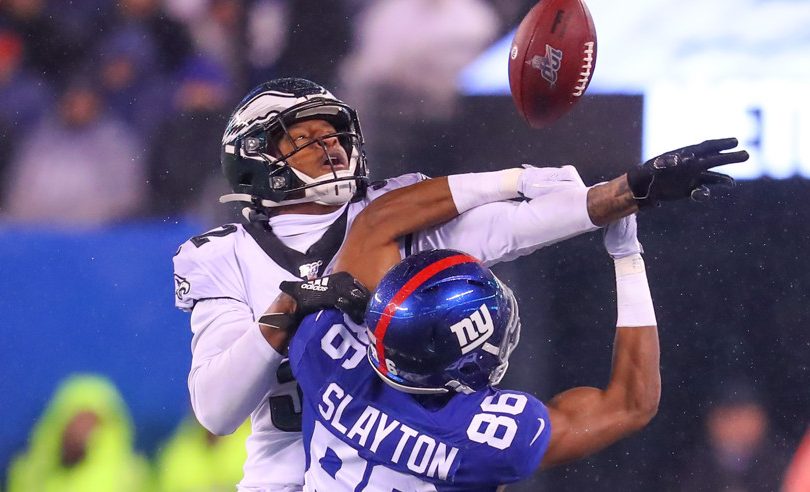
Division Games don't produce more upsets, but they might produce more fights (Photo by Rich Graessle/Icon Sportswire)
One common myth in Survivor Pools is that you should avoid division games if possible. Presumably, this is because of some belief that division games between rivals are less predictable, and more subject to upsets occurring.
The facts do not support avoiding division games in Survivor, and in fact, you may be giving away value if you adopt such a hard-and-fast rule.
Golf Pool Picks
Get an edge in your One And Done and Majors pools
Why It’s Wrong
Going back to 2002, when the current NFL divisions were formed, favorites of five points or more — the types of teams that often end up as survivor pool picks — have won 77.4% of their division matchups, yet only 75.5% of their non-division regular season matchups.
You read that right. Over the last 22 years, with sample sizes over 1,000 games each, division rivalry games have resulted in fewer upsets (among likely survivor picks) than non-division games have. And that outcome is not on account of division games simply featuring higher spreads. Here is a breakdown of division vs. non-division game results by point spread ranges.
| Division | Non-Division | |||||
|---|---|---|---|---|---|---|
| Spread Range | W | L | Win % | W | L | Win % |
| 5 to 6.5 points | 223 | 103 | 68.3% | 402 | 186 | 68.3% |
| 7 to 8.5 points | 228 | 64 | 78.0% | 353 | 126 | 73.6% |
| 9 to 10.5 points | 185 | 44 | 80.8% | 284 | 63 | 81.8% |
| 11 to 12.5 points | 58 | 10 | 85.3% | 84 | 15 | 84.8% |
| 13 to 14.5 points | 62 | 7 | 89.3% | 111 | 22 | 83.5% |
| 15+ points | 31 | 1 | 96.9% | 44 | 2 | 95.7% |
| TOTAL | 787 | 229 | 77.4% | 1278 | 414 | 75.5% |
In the majority of spread ranges, division favorites had a higher win%, and were never below the win rate of non-division favorites in the bins used above.
Don’t Fall For the Myth
Believing in a myth has real-world consequences. If you remove teams from consideration right away, that limits your choices in Survivor pools. You may be ignoring your best option in a given week if you abide by such a rule. Further, if a large enough group of entries ignores division matchups, that lowers the popularity and improves the EV for others actually picking those games.
Stop falling for it. There is no evidence that divisional favorites perform any worse in Survivor pools. Betting markets are pretty good about taking information into account. They know that these are division games, and any risk has already been priced into the odds for the game. The same goes four our predictive models, and for the win odds we use in the Survivor tools.
That’s an opportunity you can exploit. And if you have been blindly trusting this advice, just stop already.
Golf Pool Picks
Get an edge in your One And Done and Majors pools