Why the Dolphins Are Crushing NFL Survivor Future Value in 2026
If you have looked at our NFL Survivor Future Value numbers this season and thought they seemed unusually low, you’re right. Entering Week 4, the highest Future Value rating for a 1,000-entry pool belongs to the Los Angeles Rams at just 2.8. Over the past five years, the No. 1 team in our Future Value […]
by Jason Lisk - Oct 2, 2026
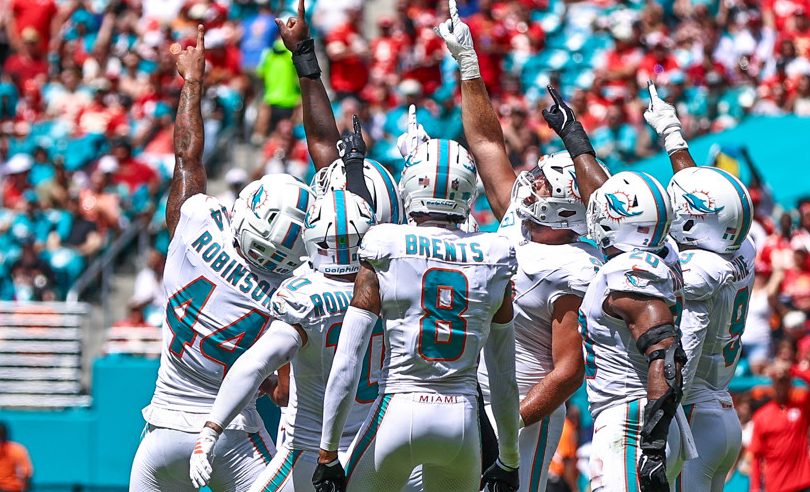
Just pick against the Dolphins, they say
If you have looked at our NFL Survivor Future Value numbers this season and thought they seemed unusually low, you’re right.
Entering Week 4, the highest Future Value rating for a 1,000-entry pool belongs to the Los Angeles Rams at just 2.8. Over the past five years, the No. 1 team in our Future Value rankings entering Week 4 has averaged a score of 6.7.
The difference is particularly striking at the top.

That does not mean there aren’t valuable teams worth saving in 2026.
Instead, the cost of using those teams now is lower than it has typically been at this point in the season.
And one reason for that is the Miami Dolphins.
Premium Sports Picks
Betting - Survivor - Pick’em
The Dolphins Are Making Too Many Other Teams Useful
Future Value is ultimately about opportunity cost.
When you use a team today, what are you giving up later?
A team becomes extremely valuable to preserve when it has lots of future weeks where it projects as one of the best survivor options available. If only a few teams can fill those premium spots, saving them becomes particularly important.
That’s not what the 2026 schedule currently looks like.
Take Miami. Here’s a sampling of teams that get to face the Dolphins over the rest of the season:
- Week 5: Cincinnati — 77% projected win odds
- Week 7: NY Jets — 66%
- Week 10: Indianapolis — 72%
- Week 11: Buffalo — 86%
- Week 13: Denver — 82%
- Week 15: Green Bay — 78%
- Week 17: Buffalo — 78%
- Week 18: New England — 81%
Even the Jets, at a relatively modest 66%, currently project as a Top-3 survivor option in Week 7.
Instead of one elite team accumulating a bunch of premium survivor weeks, Miami is effectively handing those opportunities to a rotating cast of teams.
Tennessee and the New York Giants create a similar effect.
The result is that the best future survivor opportunities are spread throughout the league.
Nineteen Teams Project As A Top-3 Option Somewhere
For each remaining week, we looked at the three highest projected win odds, including any ties for third.
From Weeks 5 through 18, 19 different teams appear as a Top-3 option at least once.
Even the leaders don’t dominate the schedule.
Cincinnati and the Rams lead with five Top-3 appearances apiece. That’s only five of the 14 remaining weeks, or about 36%.
Baltimore appears four times. Buffalo, Dallas, Detroit, Houston, Kansas City and Seattle each appear three times.

That is an important distinction from some previous seasons.
There have been years when the teams with the highest Future Values projected among the week’s very best survivor options in half or more of the remaining weeks.
Those teams were incredibly expensive to use early.
If a team could potentially solve seven or eight different future weeks, keeping it available gave you enormous flexibility. It also allowed the field’s eventual usage of that team to be spread across many different weeks.
In 2026, even the best teams give you fewer opportunities to cash in that advantage.
A team such as Cincinnati or the Rams can still become a very attractive play when one of its best weeks arrives. If picks concentrate heavily on that team in that particular week, saving it can still produce meaningful EV.
But that’s different from having an elite team available for half the remaining schedule.
The best teams can still reward you for saving them. They just don’t give you as many chances to cash in that advantage.
Miami, Tennessee and the Giants Keep Creating the Best Picks
We can flip the analysis around and look at the opponent in every Top-3 survivor spot.
That makes the source of all this dispersion even clearer.

Miami and the Giants are each responsible for eight of those Top-3 opportunities. Tennessee accounts for six more.
That’s 22 Top-3 appearances created by those three opponents alone.
But those opportunities don’t belong to the same favorite every time.
They rotate.
Buffalo gets Miami. Then Denver does. Then Green Bay. Then New England.
Jacksonville gets Tennessee. Detroit gets Tennessee. Dallas gets Tennessee. Baltimore gets Tennessee.
That creates plenty of good future survivor options without creating nearly as many irreplaceable teams.
And that’s bad for Future Value.
The Best Teams Have Another Problem: Tougher Schedules
There is a second force working in the same direction.
Some of the teams that might otherwise accumulate huge Future Values simply don’t have schedules conducive to doing it.
The NFC West is the most obvious example.
The Rams have started 1-2. Seattle remains highly rated, while Arizona has rated better than expected entering the season. That makes the divisional schedule tougher than it might have appeared before the season.
The Rams illustrate this well.
They are currently our No. 1 Future Value team for a 1,000-entry pool, but their schedule doesn’t feature a long string of overwhelming spots. They project at 80% against Arizona in Week 6, but most of their other good opportunities are in the 70% range or below.
That’s still a useful survivor team.
It’s just not the type of future schedule that produces the enormous preservation premium we’ve seen from the top Future Value teams in some previous seasons.
More Options Can Make Survivor Strategy More Complicated
There is one other consequence of this flatter Future Value landscape.
Having more options doesn’t necessarily make survivor easier.
In some past seasons, a few teams had such enormous Future Values that the basic strategy was relatively clear: avoid using them until you needed them. When a team projects as one of the best survivor choices in half of your remaining weeks, preserving it gives you lots of ways to use it later.
The 2026 schedule looks more like a puzzle.
The Rams and Cincinnati currently project as Top-3 options in only five of the remaining 14 weeks. Meanwhile, 19 different teams appear in the Top 3 at least once.
That means there can be several reasonable ways to navigate the season, but the value of a pick increasingly depends on what it allows you to do in the weeks that follow.
Using one team this week might look nearly identical to another choice based on win odds alone. But one path could leave you with much better options when the schedule gets difficult—or allow you to take advantage of one of those premium matchups against Miami, Tennessee or the Giants without creating a problem somewhere else.
That’s exactly the type of problem our PoolGenius Season Planner and Optimal Path tools are designed to solve.
Rather than evaluating survivor picks one week at a time, the Season Planner lets you see how today’s decision fits into the rest of your season. Our Optimal Path analysis then evaluates combinations of picks across future weeks to identify stronger ways to navigate your specific pool.
That’s particularly valuable in a season like 2026.
There may not be one team screaming SAVE ME with a Future Value of 6 or 7. Instead, the edge can come from fitting a larger number of useful teams into the right weeks.
When the survivor schedule becomes a puzzle, the advantage comes from solving more of it than your opponents do.
Premium Sports Picks
Betting - Survivor - Pick’em
The Bottom Line
Future Value is unusually flat in 2026 not because there aren’t good teams worth saving, but because there are more ways to solve the remaining schedule.
Weak teams like Miami, Tennessee and the Giants are creating premium opportunities for a rotating group of opponents. At the same time, some of the league’s better teams have fewer weeks where they clearly separate themselves from the alternatives.
That makes individual teams more replaceable—and lowers the opportunity cost of using them.
So if you’re wondering why nobody has a high Future Value rating this year, you can blame the schedule.
Or, if you want a simpler answer:
Blame the Dolphins.